
On this page
Close your bedroom door tonight and slide a sheet of paper under it. If the paper barely fits, you have just found the reason the room feels like a sealed jar by 3 a.m.
A stuffy single bedroom is rarely about the whole house. It is about one door, one closed room, and air that has no easy way back out. The supply vent keeps pushing conditioned air in, the door seals it off, and pressure builds until the airflow chokes itself.
I have tested dozens of these rooms as an HVAC tech, and the fix is usually mechanical, not magic. Let me walk you through it in order, cheapest first.
Why one closed bedroom goes stale
Most forced-air systems supply air to a bedroom but pull the return air from a central hallway. When the door is open, that works fine. Air comes in through the vent and drifts out under the door and into the return.
Close the door and you break the loop. The supply keeps blowing, but the air is trapped. In a tight modern room, that trapped air can raise pressure enough to cut supply flow by 20 to 40 percent.
For every cubic foot of air a vent pushes into a closed room, one cubic foot has to leave. If it cannot leave easily, the room goes stuffy no matter how strong the vent seems.
That trapped feeling is a mix of rising CO2 from your breathing, warmth from your body and electronics, and stalled humidity. The room does not need more cooling. It needs a path for air to escape.
Before you start: run the door-close test
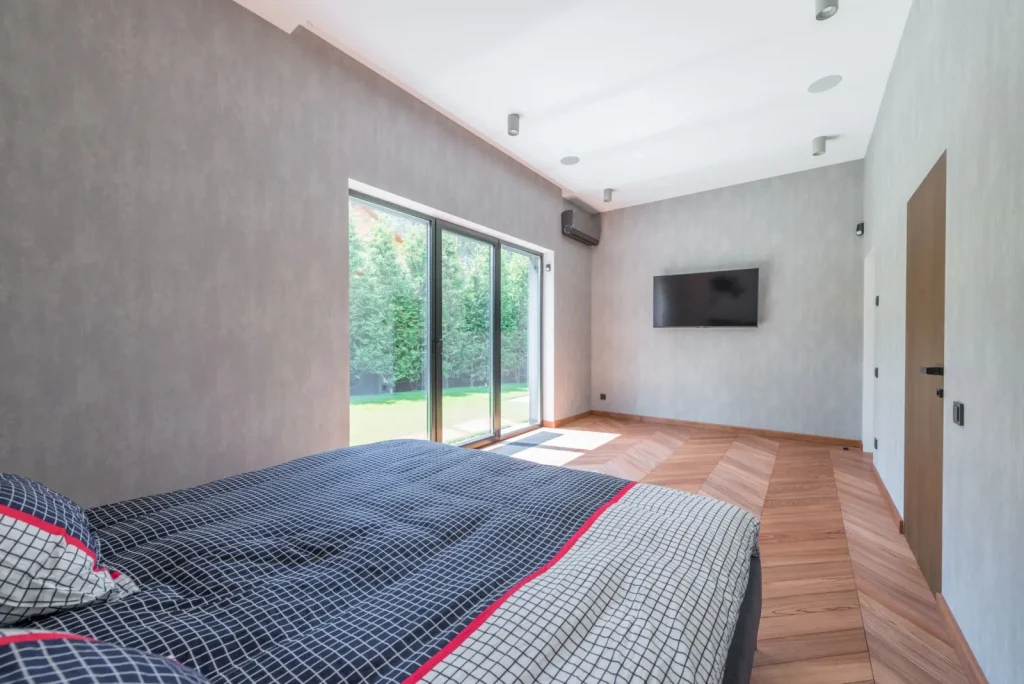
You want proof, not guesses. This 2-minute test tells you if pressure is your problem.
- Turn your HVAC fan to the ON position (not AUTO) so air moves steadily.
- Open the bedroom door fully, then close it slowly with two fingers.
- Feel for resistance near the latch, or watch if the door drifts shut or pushes back at you.
If the door resists closing or wants to swing open, the room is pressurizing. That is your green light. If it closes with no drama, your stuffiness may be a humidity or fresh-air issue instead, and different tools apply.
Hold a single square of toilet paper against the gap under the closed door with the fan running. If it flutters outward hard, air is escaping. If it barely moves, air is stuck inside.
Fix 1: Undercut the door (start here)
The simplest fix is the gap at the bottom of the door. Builders often set doors over thick carpet, then owners swap in thin flooring, and the gap shrinks to almost nothing.
A healthy undercut is about 3/4 inch to 1 inch of clear space between the door bottom and the finished floor. That gap alone can relieve a lot of pressure.
How to do it
- Measure the current gap with the door closed.
- Take the door off its hinges and mark a straight cut line 1 inch above the floor point.
- Trim with a circular saw and a clamped straightedge, then sand the edge.
- Rehang and repeat the door-close test to confirm the pressure dropped.
An undercut costs nothing but an hour of your time. The downside is honest: a bigger gap lets in more hallway light and sound. If that bothers you, move to the next fix.
Fix 2: Add a transfer grille or jump duct

When you want the airflow of a big gap without the light and noise, you install a transfer path. There are two common versions.
| Option | How it works | Rough cost | Best for |
|---|---|---|---|
| Pass-through grille | Two grilles cut into the wall, offset, connected by a short liner | $40-$90 | Sharing air with a hallway |
| Jump duct | A flex duct loops through the attic from the bedroom ceiling to the hallway | $120-$300 | Blocking sound and light better |
| Door transfer grille | A vented panel cut into the door itself | $25-$60 | Renters or quick fixes |
A jump duct is my favorite for bedrooms because the loop of duct in the attic muffles sound and blocks the straight-line light path. You cut a grille in the bedroom ceiling and another in the hallway ceiling, then connect them with a 6 to 8 inch flex duct.
A pass-through grille does the same job through a wall, which is easier if you have no attic access. Offset the two openings so you cannot see straight through, and the room stays private enough.
The first jump duct I installed for a client turned a room they called “the sauna” into their favorite place to sleep, and it cost less than a nice pair of shoes.
Do not vent a transfer grille into a bathroom, kitchen, or the outdoors. It should connect to a neutral space like a hallway. Venting to a bathroom pulls odors and moisture the wrong direction.
Fix 3: Balance or open the supply vent
Sometimes the problem is the opposite of too much air. A vent choked half-closed, blocked by a bed, or fed by a crushed flex duct starves the room.
Walk the airflow backward. Make sure the supply register is fully open, no furniture blocks it, and the damper in the duct is not shut.
Hold a tissue near the supply register with the fan running. Weak or no flutter means the problem is delivery, not escape, and you should trace the duct for kinks or a closed damper.
If the whole house has weak delivery, that is a different conversation about system sizing and duct design. But for one room, a blocked register or a partly closed damper is a common and quick culprit.
Fix 4: Add a small supply vent (last resort)
A few bedrooms, especially converted attics, offices, or additions, have no supply vent at all. They were never in the original duct plan.
Here you either extend a branch duct from the nearest trunk line or add a small dedicated source of fresh air. This is real work and usually a job for a pro, but sometimes it is the only fix that lasts.
A properly sized branch for a small bedroom typically moves 50 to 100 CFM. Pair it with a return path from Fix 2, because a new supply with no way out just recreates the original problem.
When the air is fresh but still feels heavy
If you have solved the pressure loop and the room still feels thick, the issue may be humidity or stale outdoor-air exchange rather than circulation. A room can have plenty of moving air and still feel damp at 65 percent relative humidity.
Aim to keep bedroom humidity between 40 and 50 percent. The EPA indoor air quality pages cover the health side of this well, and the Department of Energy Energy Saver site is solid on airflow and efficiency tradeoffs.
For whole-home fresh air, a balanced system moves fresh air in and stale air out on purpose. Topics like Balanced Ventilation Explained Simply and HRV vs ERV: Which One Is Right for Your Home go deeper than one bedroom needs, but they matter if several rooms feel stuffy.
Your next step tonight
Do the door-close test before you buy anything. It costs nothing and points you at the right fix instead of a random gadget.
If the door pressurizes, start with the undercut, then step up to a transfer grille or jump duct if you want quiet and privacy. Save the new supply vent for rooms that truly have none. Nine times out of ten, one closed bedroom just needs a clear path for air to leave, and once it has one, the room stops fighting you.
Frequently asked questions
How much of a gap should there be under a bedroom door for airflow?
Aim for about 3/4 inch to 1 inch of clear space between the door bottom and the finished floor. That gap gives trapped supply air a path back to the central return so the room does not pressurize. Thick carpet swapped for thin flooring is a common reason the gap shrinks and a room starts feeling stuffy.
Will a transfer grille let sound and light into my bedroom?
A door-mounted grille passes some sound and light straight through. A jump duct that loops through the attic blocks both far better because the air path bends and has length to it. An offset pass-through grille in a wall is a middle ground. If privacy matters most, choose the jump duct over a simple door panel.
Can I fix a stuffy bedroom without any construction?
Often yes. Set the HVAC fan to ON instead of AUTO, fully open the supply register, clear furniture off the vent, and crack the door or use a door-bottom vent. These no-build steps relieve pressure in many rooms. If the room stays stuffy only with the door fully closed, you likely need a permanent return path like a grille or undercut.
Why does my bedroom get stuffy only at night with the door closed?
At night the door stays shut for hours, so the pressure loop never resets and CO2 from your breathing builds up. Your body and any electronics add heat, and stalled humidity makes it worse. Open airflow during the day masks all of this. The fix is giving the closed room a steady way for air to escape back to the return.
Does adding a supply vent alone fix a stuffy room?
Not by itself. A new supply vent pushes more air in, but if that air still cannot escape a closed door, you just recreate the pressure problem at a higher volume. Always pair a new supply with a return path, either a door undercut, a transfer grille, or a jump duct, so incoming and outgoing air stay balanced.

Dharm Solanki
Dharm Solanki spends a lot of time thinking about the air inside people's homes, usually when no one else is. He writes about humidity, ventilation, and dehumidifiers, along with the small fixes that turn a stuffy or damp room into one that feels comfortable again. He would rather explain why a recommendation works than just point at a product, so his guides tend to answer the question you were about to ask next. And if something looks great on paper but struggles in a normal house, he says so.