On this page
The first service call that taught me this lesson was a finished basement in October. The homeowner had bought a decent 50-pint unit, run it for three weeks, and still had that damp, closed-locker smell. The dehumidifier was doing its job. The problem was where it sat: jammed into a corner behind a sofa, back grille pressed against drywall, pulling from about four inches of stale air.
We moved it eight feet, out toward the middle of the room, and within two days the humidity dropped from 68 percent to the low 50s. Same machine. Same settings. Different spot.
Placement is the cheapest upgrade you will ever make to a dehumidifier, and it costs nothing. Here is how to get it right.
Before you start: know your machine and your moisture source
Two quick things decide almost everything about placement. First, what type of unit you own. Most home dehumidifiers are compressor (refrigerant) models, and those need real airflow around them. A few are desiccant models, which are quieter and care a little less about clearance but still want an open intake.
Second, find where the water is coming from. Walk the room with an inexpensive hygrometer and note the wettest spot. A shower wall, a laundry pair, a foundation corner that weeps after rain, a window that fogs every morning. That reading tells you which end of the room to favor.
Take a humidity reading in three or four spots before you commit to a location. Damp air pools low and near cold surfaces, so the corner by the foundation often reads 10-15 points higher than the center of the room.
Give it room to breathe: clearance rules that actually matter
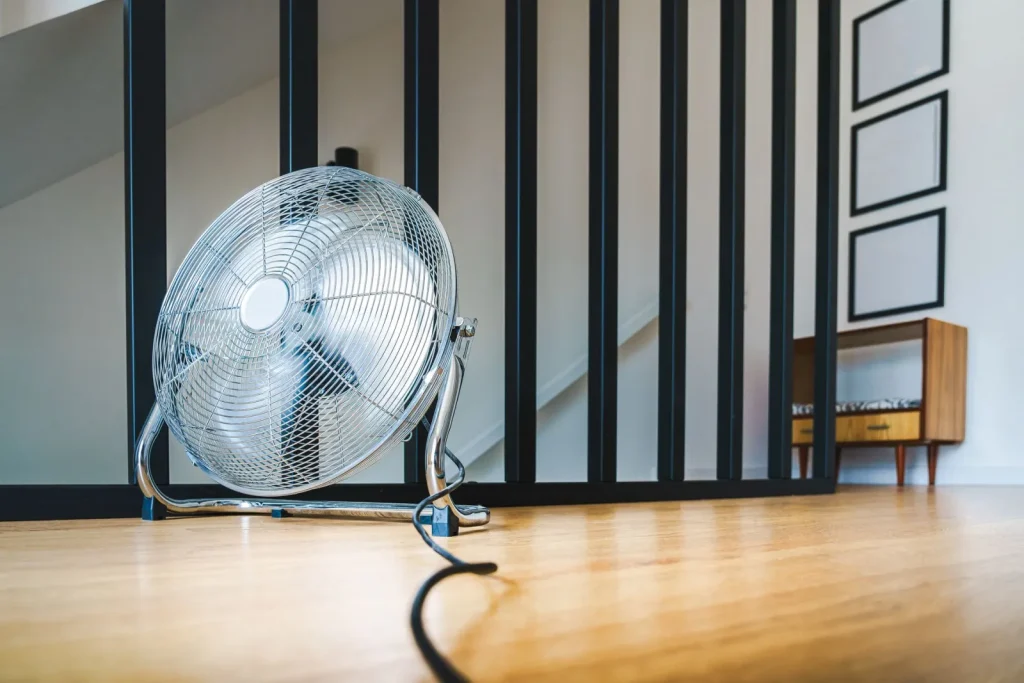
A compressor dehumidifier pulls moist air in through one grille and pushes drier air out through another. Block either one and the machine chokes on its own recycled air.
The clearance most manufacturers ask for is a good starting point, and it is worth following even when the manual is buried in a drawer.
| Surface | Minimum clearance | Why it matters |
|---|---|---|
| Intake grille (usually the back) | 6-12 inches | Starved intake means the unit re-breathes dry air and reads the room as done |
| Exhaust grille (top or front) | 12-18 inches | Warm dry air needs to leave and mix, not bounce straight back in |
| Sides | 6 inches | Keeps the coil ventilated and the compressor from overheating |
| Above (top-discharge models) | 18-24 inches | No low shelf or countertop trapping the exhaust |
If your model blows air out the top, never set anything on it and never slide it under a workbench. If it discharges from the front, do not point that stream directly at a wall two feet away.
Pushing the unit tight against a wall to hide it is the single most common placement mistake I see. It can cut effective performance by a third and makes the compressor cycle harder, which shortens its life and raises your power bill.
Center of the room usually wins
People want to hide these machines, and I understand the impulse. But a dehumidifier works on the whole air mass in a room, and it dries fastest when air can circulate freely to it from every direction.
A spot that is open on most sides, roughly central, or near a doorway where air naturally moves, will out-dry a tucked-away corner almost every time. You do not need it dead-center like a coffee table. You need it out of the dead air.
A dehumidifier does not chase moisture across a room. It treats the air that reaches it, so your job is to make sure the wet air can actually get there.
When to break the center rule
There is one good reason to move off-center: a strong, localized source. If one wall is visibly damp or a laundry area dumps humidity in a hurry, shift the unit toward that source while still keeping its grilles clear. You are meeting the moisture closer to where it enters the room.
Which room to prioritize with a single unit
Most homes have one portable dehumidifier and several damp candidates. You cannot be everywhere, so pick the room that is both the wettest and the most connected to the rest of the floor.
Treat the source, not the symptom. If upstairs windows fog every morning but the basement is the actual moisture engine for the house, put the unit in the basement and let drier air rise.
A basement is usually the right first choice. It is the coolest, dampest level, and moisture there migrates upward through the house. Sizing the machine to the space matters too, but that is a separate question from placement. If you are unsure how big a unit the room needs, our guide on how to size a dehumidifier by pints walks through the math.
For an open floor plan, position the unit near the junction of the spaces or in an open doorway so it can pull from more than one room. For closed rooms, keep the door open a few inches or the machine will simply dry one small volume and quit.
Floor, height, and the surface underneath
Where the unit sits vertically matters more than people expect. Cool damp air settles low, so floor level is often the right height in a basement or garage. In a living space where the floor is already comfortable, a stable low platform can help the exhaust mix into the room.
- Set it on a hard, level surface, not deep carpet that can block a bottom intake.
- Keep at least 6 inches from furniture legs, bins, and boxes on every side.
- Route the drain hose downhill to a floor drain if you are using continuous drainage, so the tank never becomes the limit.
- Keep it away from dusty sources like a workshop sander, which clogs the filter fast.
- Leave the exhaust path open toward the room, never into a closet or dead alcove.
If you rely on the collection tank instead of a hose, put the unit somewhere you will actually see it fill, or you will find it switched off on a full bucket during the wettest week of the year.
Temperature and the spots to avoid
Compressor units lose efficiency in cold rooms because the coil frosts. If your space runs below about 60 degrees Fahrenheit, keep the unit off exterior walls and away from cold drafts, or consider a desiccant model that handles the cold better.
Avoid setting the machine right beside a heat source or in direct sun, which confuses its humidity sensing. And keep it clear of the fine dust of a laundry area or the lint path of a dryer, both of which choke the filter.
For general targets, the EPA suggests keeping indoor humidity below 60 percent, ideally 30-50 percent. You can read more on the EPA indoor air quality pages, and the Department of Energy Energy Saver site has useful notes on running these units without wasting power.
A five-minute placement pass
Put the unit roughly central or near an open doorway, grilles clear by at least six inches, sitting on a hard level surface near your dampest source. Open interior doors a crack, point the exhaust into the room, and give it 48 hours before you judge it.
Then re-check with your hygrometer. If the number is falling, you found the spot. If it is stuck, nudge the machine toward the moisture and clear whatever is crowding the intake. Small moves, measured results, and one machine can quietly handle far more room than most people give it credit for.
Frequently asked questions
Should a dehumidifier go in the middle of the room or against a wall?
Aim for open, roughly central placement, or a spot near a doorway where air moves. A dehumidifier treats the air that reaches it, so it dries faster with clearance on all sides. If you must place it near a wall, keep the intake grille at least 6 to 12 inches off the surface so it does not re-breathe its own dry air.
How much clearance does a dehumidifier need?
Give a compressor unit 6 to 12 inches on the intake side, 6 inches on the sides, and 12 to 18 inches for the exhaust. Top-discharge models want 18 to 24 inches of open space above them. Never set anything on top or slide the machine under a shelf, since blocked grilles can cut performance by roughly a third.
Which room should I put my only dehumidifier in?
Prioritize the wettest, most connected space, which is usually the basement. Basements are cool and damp, and that moisture migrates upward through the house. Treating the source there does more than chasing symptoms like foggy upstairs windows. Take readings in a few rooms and let the highest number decide.
Can I put a dehumidifier on carpet?
It is better on a hard, level surface. Deep carpet can block a bottom-mounted intake and let the unit tip on uneven pile. If the only option is carpet, use a thin hard board or tray underneath to keep the base level and the air path open, and check that no grille sits flush against the fibers.
Does a dehumidifier need to be near a window or drain?
It does not need a window. A nearby floor drain helps only if you use continuous drainage through a hose, which lets you skip emptying the tank. Position for airflow and moisture source first, then route the drain hose downhill to the drain if one is close. Airflow beats plumbing convenience every time.
How long before I know the placement is working?
Give it about 48 hours, then re-check with a hygrometer. A good spot shows a steady drop, often 10 to 15 points over a few days in a damp room. If the reading is stuck, move the unit toward the moisture source and clear anything crowding the intake or exhaust before you blame the machine itself.

Dharm Solanki
Dharm Solanki spends a lot of time thinking about the air inside people's homes, usually when no one else is. He writes about humidity, ventilation, and dehumidifiers, along with the small fixes that turn a stuffy or damp room into one that feels comfortable again. He would rather explain why a recommendation works than just point at a product, so his guides tend to answer the question you were about to ask next. And if something looks great on paper but struggles in a normal house, he says so.