On this page
A homeowner once showed me a photo of a dark band running across her dining room wall, about knee height, straight as a shelf. She had already bought two dehumidifiers and repainted twice. The paint kept bubbling back within a month, and she was convinced the room just breathed too much moisture.
It was rising damp. No amount of air drying was going to touch it, because the water was not coming from the air. It was coming up out of the ground.
That mix-up is common, and it is expensive. Chase the wrong cause and you spend money on the wrong fix. So let me walk you through what rising damp actually is, the one clue that gives it away, and how to tell it apart from the two problems people confuse it with.
What rising damp actually is
Rising damp is groundwater climbing up through the pores of your walls. Brick, stone, and mortar act a bit like a stack of sugar cubes touching a puddle. Water wicks upward through tiny capillaries, defying gravity until it runs out of push.
In most homes that climb tops out somewhere between 50 cm and 1 meter (roughly 20 inches to 3 feet). Above that height the evaporation from the wall surface balances the water being drawn up, and the damp stops.
Modern buildings are supposed to block this. Somewhere near the base of the wall sits a damp proof course, or DPC, a physical barrier of slate, bitumen, or plastic laid into the masonry to stop moisture rising past it. When that barrier is missing, damaged, or bridged, the water climbs freely.
If a damp patch is low on the wall, roughly level all the way along, and never fully dries out no matter the season, rising damp is your prime suspect.
The tide mark: the telltale sign
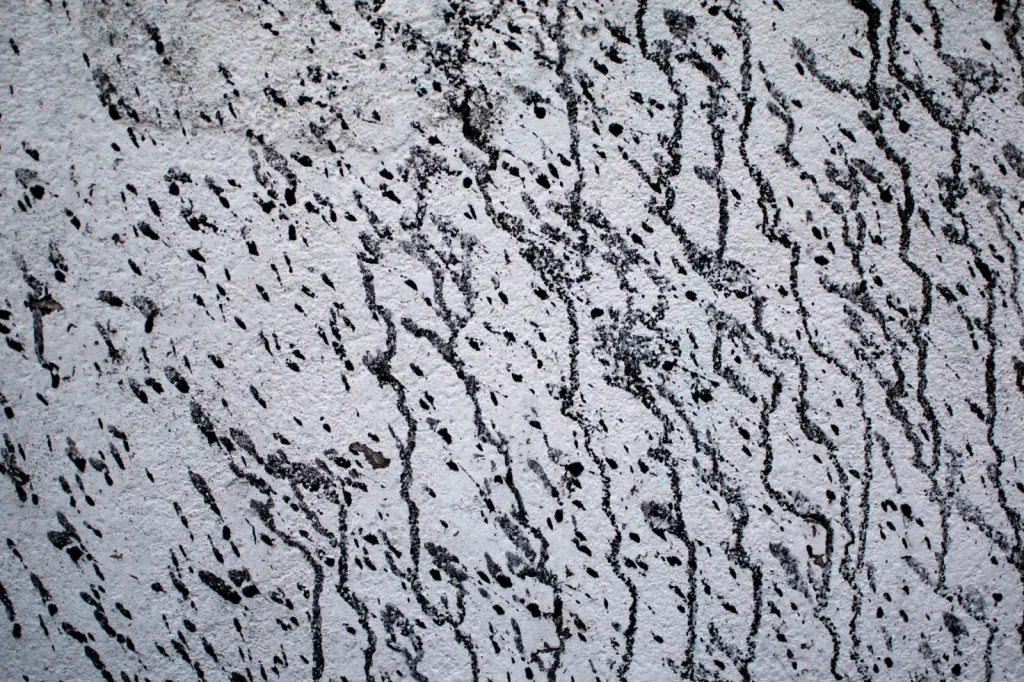
The single most useful clue is the tide mark. It is a horizontal stain, often yellowish, brown, or with a faint white bloom, marking the highest point the water reached before evaporating.
It looks like the line a receding tide leaves on a beach, which is exactly where the name comes from. Because groundwater carries dissolved salts (nitrates and chlorides pulled from the soil and the masonry), those salts get left behind at the top of the climb as the water evaporates.
You can sometimes feel them. Run a finger along the mark and you may pick up a slightly gritty or powdery residue. Those hygroscopic salts hold onto moisture from the air too, which is why a wall with old rising damp can feel clammy even after you have fixed the source.
The tide mark is the wall telling you exactly how high the water got. Read it like a ruler.
Other giveaways travel with it: peeling paint and blown plaster in that low band, crumbling mortar near the base, and skirting boards that feel soft or lift away from the wall. Wallpaper in the affected zone tends to bubble and let go along the same line.
How it differs from condensation
Condensation is the problem people most often mistake for rising damp, and the two behave nothing alike.
Condensation forms when warm, moisture-laden indoor air hits a cold surface and the water vapor turns back into liquid. Think of a cold drink sweating on a summer day. It shows up on windows, in corners, behind furniture pushed against outside walls, and in cold spots high and low, not in a tidy horizontal band near the floor.
| Feature | Rising damp | Condensation |
|---|---|---|
| Location | Low on wall, below ~1 m | Windows, corners, cold surfaces, any height |
| Pattern | Horizontal tide mark | Droplets, black mold spots, streaks |
| Source of water | Ground moisture | Humid indoor air |
| Salt residue | Yes, at the tide mark | No |
| Worst season | Fairly constant year round | Cold months, when heating meets cold walls |
| Helped by a dehumidifier | No | Yes |
That last row matters. If a dehumidifier or better airflow clears the problem, you had condensation. If it does not budge, you are dealing with something the air cannot reach. This is where our guide on condensation on interior walls and the piece on condensation on windows are worth a read, because they cover fixes that genuinely work for air-borne moisture.
How it differs from penetrating damp
Penetrating damp is water coming sideways through the wall rather than up from the ground. It follows a defect: a cracked render, a leaking gutter, a failed window seal, spalled brickwork, or a downpipe dumping water against the masonry.
The pattern tells the story. Penetrating damp shows up as a localized patch, often high or mid-wall, right where the fault is, and it flares after heavy rain. It does not respect a neat horizontal line, and it usually lacks the salt tide mark.
Watch a suspicious patch through a wet week. If it darkens noticeably during and after rain, lean toward penetrating damp. If it stays about the same through dry and wet spells, rising damp is more likely.
A quick side-by-side
- Low, level, salty tide mark that stays constant: rising damp
- High or mid-wall droplets and mold on cold surfaces: condensation
- Isolated patch that worsens with rain, tied to a visible defect: penetrating damp
Why the right diagnosis saves you money
Each of these problems has its own fix, and none of them overlaps. Spend on the wrong one and you have thrown money at a symptom.
Condensation responds to ventilation, heating cold surfaces, and pulling humidity out of the air. Penetrating damp needs the actual defect repaired: reseal the window, fix the gutter, repoint the brick. Rising damp needs the damp proof course restored.
A common and costly mistake is treating true rising damp with a dehumidifier and fresh paint. The machine dries the room air, the paint hides the stain for a few weeks, and then the salts and moisture push right back through. You have not touched the cause.
Repainting over a tide mark without treating the source almost always fails. The moisture and salts return, and trapped damp behind fresh paint can make the blistering worse than before.
What actually fixes rising damp
The real repair is a working damp proof course. If the original DPC has failed or was never there, the usual remedy is a chemical DPC: a water-repellent cream or fluid injected into a line of holes drilled along the base of the wall, forming a fresh barrier. Expect a professional injection job to run roughly $50 to $120 per linear meter in the United States, and more once you add replastering.
Replastering matters as much as the barrier. Those ground salts stay in the old plaster and keep drawing moisture from the air, so the damaged plaster in the affected band usually has to come off and go back on with a salt-resistant mix.
Sometimes the DPC is fine and the problem is a bridge: soil, a raised flower bed, a new patio, or piled render lets water skip over the barrier. Lowering the external ground level below the DPC line can solve it without any injection at all.
For a wall drying out after treatment, a dehumidifier does have a supporting role. It will not cure rising damp, but it speeds the drying of newly repaired plaster and manages the clammy feel from residual salts while things settle.
If you want to confirm your reading before calling anyone, the U.S. EPA has solid background on moisture and indoor air at its mold and moisture pages, and the Department of Energy covers moisture control in its Energy Saver resources.
Your next step
Go stand in front of the damp patch and answer three questions. Is it low and roughly level? Is there a salty tide mark? Does it stay damp regardless of the weather? Three yeses point firmly at rising damp and a damp proof course problem.
If the answers point elsewhere, you have just saved yourself the cost of a repair you did not need. That homeowner with the bubbling dining room eventually had a chemical DPC injected and the wall replastered. Two years on, the paint has stayed put, and both dehumidifiers moved to the basement where they were actually useful all along.
Frequently asked questions
Can a dehumidifier fix rising damp?
No. A dehumidifier dries the air, but rising damp is groundwater climbing through the wall from below, so the source is never the air. It can help dry newly replastered walls after a proper repair and ease the clammy feel from leftover ground salts, but on its own it will not stop the moisture rising.
How high does rising damp usually climb?
In most homes it reaches somewhere between 50 cm and 1 meter, or about 20 inches to 3 feet, before stopping. Above that point, water evaporating from the wall surface balances the moisture being drawn up, which is why the tide mark forms a fairly level horizontal line rather than spreading up the whole wall.
What is a damp proof course?
A damp proof course, or DPC, is a waterproof barrier built into the base of a wall to block ground moisture from rising into the masonry. It is often slate, bitumen, or plastic in newer homes. When it fails, is missing, or gets bridged by soil or a raised patio, rising damp can climb past it.
How do I tell rising damp from condensation?
Look at location and salt. Rising damp sits low on the wall in a level band with a gritty, salty tide mark and stays constant through the year. Condensation appears on cold surfaces like windows and corners at any height, shows as droplets or black mold, has no salt residue, and gets worse in cold months.
Is rising damp expensive to repair?
The main cost is restoring the damp proof course, often a chemical DPC injected into the wall base, which tends to run roughly 50 to 120 dollars per linear meter in the United States before replastering. Replastering with a salt-resistant mix adds to the bill. Sometimes the fix is cheaper, such as simply lowering soil that is bridging a working DPC.
Why does painting over the damp patch never work?
The stain comes from moisture and dissolved ground salts pushing through the plaster. Fresh paint hides it briefly, but the salts pull moisture from the air and the damp keeps rising, so the paint blisters and peels within weeks. Trapping damp behind new paint can even make the blistering worse. You have to treat the source first.

Dharm Solanki
Dharm Solanki spends a lot of time thinking about the air inside people's homes, usually when no one else is. He writes about humidity, ventilation, and dehumidifiers, along with the small fixes that turn a stuffy or damp room into one that feels comfortable again. He would rather explain why a recommendation works than just point at a product, so his guides tend to answer the question you were about to ask next. And if something looks great on paper but struggles in a normal house, he says so.