
On this page
The first evaporative humidifier I ever serviced looked broken. The homeowner swore it was empty, the tank still had water, and she could not see a lick of mist coming out of it. She wanted her money back.
Nothing was wrong. That is just how these machines work. They move moisture in a way you cannot see, and that quiet, invisible operation trips up a lot of first-time buyers.
So let me walk you through what an evaporative humidifier actually is, how it manages humidity almost on its own, and what you sign up for in upkeep.
How a wick and fan evaporative humidifier works
Strip one down and you find only three real parts: a water tank, a wick, and a fan. There is no heating element and no vibrating disc. The whole thing runs on plain evaporation, the same process that dries a wet towel on a line.
Water from the tank drips into a base tray. A wick filter, usually a stiff honeycomb pad, sits in that tray and soaks the water up like a paper towel standing in a puddle.
The fan then pushes room air straight through that damp wick. As dry air passes across the wet surface, it picks up water molecules and carries them off as vapor. What leaves the machine is not fog. It is just slightly moister, cooler air.
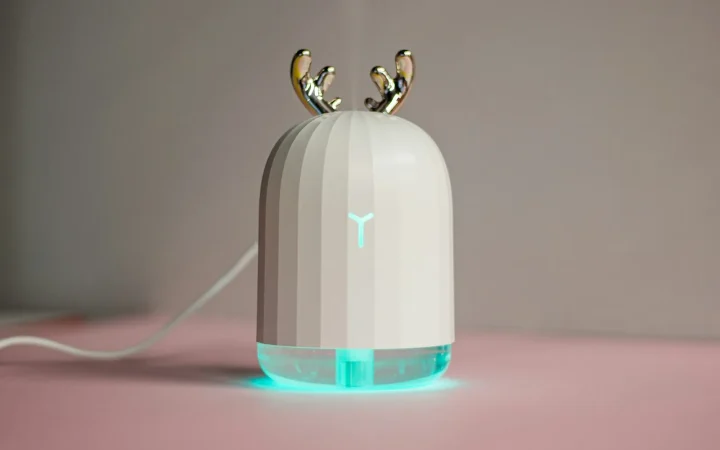
If you can see a plume, it is probably an ultrasonic or a warm mist unit. A true evaporative humidifier gives you humidity you feel, not a cloud you watch.
Why the mist is invisible
Visible mist is made of tiny liquid droplets suspended in the air. Evaporation skips that stage entirely and turns water directly into gas, which your eyes cannot register.
This matters more than it sounds. Because there are no droplets, nothing lands wet on your nightstand, and dissolved minerals mostly stay behind in the wick instead of settling on your furniture.
The self-regulating trick that keeps humidity in check
Here is the part I love about these units, and the reason I still recommend them to nervous first-timers.
Evaporation speeds up in dry air and slows down in damp air. That is basic physics, and an evaporative humidifier rides it perfectly. When your room is parched at 25 percent relative humidity, the wick gives up water fast. As the air fills toward a comfortable 40-50 percent, evaporation naturally tapers off.
An evaporative humidifier struggles to push a normal room much past roughly 60 percent relative humidity. That built-in ceiling is a feature, not a flaw, because over-humidifying invites mold and dust mites.
Compare that to an ultrasonic unit, which happily blasts the same amount of moisture into a room whether it is bone dry or already swampy. Those need a humidistat and your attention to avoid soaking a window sill. The evaporative design leans on nature to do the throttling.
It is not magic and it is not laboratory-precise. But for a bedroom or a small living room, that gentle self-limiting behavior means you can run it overnight without waking up to condensation running down the glass. The EPA’s guidance on indoor moisture puts the healthy target at 30-50 percent, and this style of humidifier tends to settle right in that band on its own.
What upkeep really looks like
No humidifier is maintenance-free, and anyone who tells you otherwise is selling something. The evaporative kind trades one chore for another.
You skip the daily mineral-dust wipe-down that ultrasonic owners deal with. In exchange, you commit to caring for the wick and the tank, because you are running a warm, wet, breezy environment that bacteria and mold would love to move into.
Your regular routine
- Empty and refill the tank with fresh water daily. Standing water grows things.
- Rinse the base tray every few days to clear slime and mineral grit.
- Deep clean weekly with a diluted white vinegar solution, then rinse well.
- Flip or rotate the wick occasionally so it wets evenly and does not stiffen on one side.
- Replace the wick filter every 1-3 months, sooner if you have hard water.
The wick is the one true consumable. Over time, minerals from your tap water cake into the pad and clog those tiny channels. A crusty, hardened wick cannot soak up water, so output quietly drops off. Replacements usually run $8 to $20 depending on the model.
Never let a damp wick sit in a closed, warm machine for days. If you are storing the unit or going away, run it dry or pull the wick out completely. A forgotten wet wick is how you get that sour, musty smell and, worse, mold spores blowing into your air.
Using distilled or filtered water stretches wick life and cuts down on scale. It costs more, but if your tap water leaves white rings in your kettle, it is worth it here too.
The honest pros and cons
I try never to oversell one type. Every humidifier is a set of tradeoffs, so here is where the evaporative design shines and where it does not.
| Strength | Tradeoff |
|---|---|
| No white mineral dust on furniture | Fan makes a steady whooshing noise, not silent |
| Self-regulating, hard to over-humidify | Cannot force very high humidity if you want it |
| Cool output, safe around kids and pets | Slightly cools the room, unwelcome in winter for some |
| Simple, cheap parts, easy to understand | Wick is an ongoing replacement cost |
| Minerals trapped in wick, not airborne | Does not kill bacteria, so cleaning is non-negotiable |
One point deserves emphasis. An evaporative humidifier does not sterilize water the way a warm mist unit does by boiling it. It relies on you keeping the tank clean. If cleaning slips, the fan will happily distribute whatever is growing in there. That single fact should decide whether this style fits your habits.
The cool, dry-feeling output is also worth flagging. On a raw January night, some people find that faint chill unpleasant and prefer a warm mist model instead. In a stuffy summer bedroom, that same coolness is a small bonus.
Set the unit on a hard surface a few feet off the floor and away from walls, not deep in a corner. The fan needs clear airflow on both the intake and output sides to evaporate efficiently and spread moisture through the room.
Is this the right humidifier for you
An evaporative humidifier is a strong first pick if you want low fuss around the humidity level, no dust film to wipe up, and a design simple enough that you can troubleshoot it yourself.
It is a weaker fit if silence is your top priority, if you hate consumable parts, or if you specifically need to drive humidity high for a plant room or a musical instrument.
If you are still weighing options, it helps to look at how this stacks up against other designs. The comparisons in Evaporative vs Ultrasonic Humidifiers Compared and Warm Mist vs Cool Mist Humidifier cover those tradeoffs in detail, and if you have not settled on a size yet, How to Size a Humidifier for a Room is the next thing I would read.
Your practical next step is small. Before you buy, check your tap water hardness and count on a wick every couple of months. If that upkeep sounds fair to you, this quiet, self-limiting little machine will keep a room comfortable without ever asking you to babysit a humidistat.
Frequently asked questions
Why can't I see any mist from my evaporative humidifier?
You are not supposed to. This type turns water directly into invisible vapor instead of spraying visible droplets. If your tank level is dropping and the air feels less dry, the unit is working fine. A visible plume actually points to a different technology, like ultrasonic or warm mist, so seeing nothing is a good sign here.
How often do I really need to replace the wick filter?
Most wicks last 1 to 3 months, but hard water shortens that. When output drops or the pad feels stiff and crusty with mineral scale, it is done. Running distilled or filtered water helps it last longer. A replacement wick typically costs $8 to $20, so budget for a few per year depending on your water and how often you run it.
Can an evaporative humidifier over-humidify a room?
It is much harder than with other types. Evaporation slows down as the air gets damp, so the unit naturally tapers off as a room approaches comfortable humidity and rarely pushes past about 60 percent. In a very small, sealed room run nonstop you could still get high, but for normal use this self-regulating behavior is one of its best features.
Does an evaporative humidifier kill bacteria in the water?
No. Unlike a warm mist unit that boils the water, an evaporative model runs cool and does not sterilize anything. It relies on you keeping the tank and tray clean. Skip cleaning and the fan can distribute mold or bacteria into your air. Fresh water daily and a weekly vinegar clean are not optional with this design.
Will an evaporative humidifier make my room colder?
Slightly, yes. Evaporation absorbs a small amount of heat, so the output air feels cool and can take the edge off a warm room. The effect is minor and usually unnoticeable, but on a very cold winter night some people prefer a warm mist humidifier instead. In summer, that faint coolness can be a mild bonus.

Dharm Solanki
Dharm Solanki spends a lot of time thinking about the air inside people's homes, usually when no one else is. He writes about humidity, ventilation, and dehumidifiers, along with the small fixes that turn a stuffy or damp room into one that feels comfortable again. He would rather explain why a recommendation works than just point at a product, so his guides tend to answer the question you were about to ask next. And if something looks great on paper but struggles in a normal house, he says so.