
On this page
- Before you start: what dry air actually does to a baby
- Step 1: Pick a cool mist humidifier, not warm mist
- Step 2: Place it safely, away from the crib
- Step 3: Size it to the room, not the store display
- Step 4: Set humidity targets and check them
- Step 5: Clean it like your baby's air depends on it, because it does
- A quick nursery setup you can copy
The first nursery I ever set up a humidifier in belonged to my sister. Her newborn had a stuffy nose and a cough that kept the whole house awake, and the pediatrician had said “get some moisture in the air.” So she bought the biggest warm mist unit on the shelf and put it on the changing table, right next to the crib.
Two things were wrong with that. The water inside got hot enough to scald, and the mist was landing on the crib rail. We fixed both in ten minutes, and the baby slept.
A humidifier for baby nursery use is one of the simplest tools for easing dry-air symptoms, but only if you get three things right: the type, the placement, and the cleaning. Let me walk you through each.
Before you start: what dry air actually does to a baby
Infants breathe faster than adults and have tiny nasal passages. When indoor air drops below about 30 percent relative humidity, usually in winter when the furnace runs, those passages dry out and congestion gets worse.
A little added moisture thins mucus, soothes irritated skin, and can quiet a dry cough. It is not a cure for a cold, and it will not fix a real respiratory illness, so keep your pediatrician in the loop.
Aim for 40 to 50 percent relative humidity in the nursery. Below 30 percent feels dry and irritating. Above 60 percent invites mold, dust mites, and that damp smell you never want in a baby’s room.
Step 1: Pick a cool mist humidifier, not warm mist

This is the single most important choice, and it is not close. For a nursery, go cool mist.
Warm mist units boil water to make steam. That means a reservoir of hot water and a heating element, both of which are a burn hazard the moment your child is old enough to reach, pull, or knock things over. The Consumer Product Safety Commission has logged scald injuries from tipped steam vaporizers for decades.
Cool mist comes in two main styles. If you want the deeper trade-offs, our Warm Mist vs Cool Mist Humidifier breakdown covers them, but here is the short version for a nursery.
| Type | How it works | Nursery notes |
|---|---|---|
| Evaporative (wick) | Fan blows air through a wet wick | Self-regulating, no white dust, but the fan hums and wicks need replacing every 1-2 months |
| Ultrasonic | High-frequency plate vibrates water into fine mist | Very quiet, great for sleep, but can spread white mineral dust and bacteria if you use tap water and skip cleaning |
Both are safe when maintained. Ultrasonic wins on quiet, which matters at 2 a.m. Evaporative wins on being harder to misuse. If you go ultrasonic, the distilled-water and cleaning habits below are non-negotiable. Our Evaporative vs Ultrasonic Humidifiers Compared piece digs into the dust question if you are torn.
Step 2: Place it safely, away from the crib
Placement is where good intentions go wrong. The mist needs to spread through the room, not soak one corner or land on your baby.
- Keep the unit at least 3 feet from the crib, farther if you can
- Set it up off the floor on a dresser or shelf, roughly 2-3 feet high, so mist disperses instead of pooling
- Never aim the nozzle directly at the baby, the crib, or nearby wood furniture
- Put a waterproof mat or tray under it to protect surfaces from drips and condensation
- Route the power cord out of reach and never run it under the crib
Damp bedding is the quiet problem here. If mist settles on the sheet or mattress, you get a cold, wet sleep surface and, over weeks, mildew. Point the output toward open floor space in the center of the room.
Do not put the humidifier on the floor next to the crib “so it is out of the way.” Floor-level mist pools, dampens the carpet, and grows mold you will not see until it smells. Up and away is the rule.
If you want the general principles beyond nurseries, Where to Place a Humidifier in a Room covers airflow and distance in more detail.
Step 3: Size it to the room, not the store display
Most nurseries run 100 to 200 square feet. A small tabletop humidifier holding 0.5 to 1 gallon is usually plenty and will run through the night without a refill.
Bigger is not better in a small closed room. An oversized unit can push humidity past 60 percent fast, and then you are fighting condensation on the windows every morning. If your nursery is on the larger side or connects to an open loft, How to Size a Humidifier for a Room walks through the math.
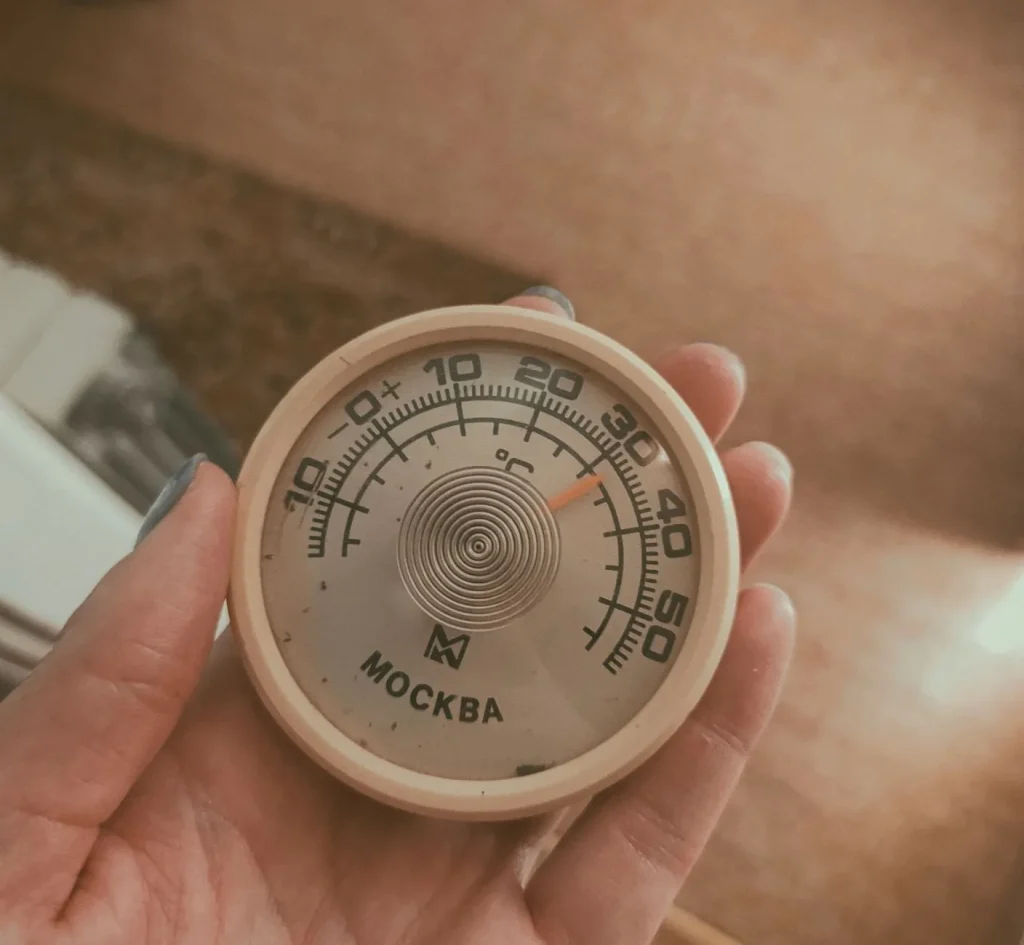
A hygrometer is the ten-dollar accessory that turns guesswork into control. Buy one before you buy a bigger humidifier.
Step 4: Set humidity targets and check them
Do not trust the room to “feel right.” Buy a small digital hygrometer, place it across the room from the humidifier, and read it daily for the first week.
Target 40 to 50 percent. If the number creeps toward 55 or 60, the humidifier is too big or running too long. Many units have a built-in humidistat that shuts off at a set level, which is worth the small price bump for a nursery.
As for runtime, most parents run the humidifier during naps and overnight, then let the room breathe during the day. How Long to Run a Humidifier Each Day gets into the specifics, but the hygrometer is your real guide.
Step 5: Clean it like your baby’s air depends on it, because it does
Here is the part nobody enjoys and everybody skips. A dirty humidifier does not just fail to help. It actively sprays mold spores, bacteria, and mineral dust into the air your infant breathes eight to twelve hours a night.
The EPA’s indoor air guidance is blunt about this: standing water plus warmth equals microbial growth. A nursery humidifier gets both. So the routine has to be non-negotiable.
The daily habit
- Empty the tank every morning and let it air out, do not top off old water
- Wipe visible moisture from the base and tray
- Refill with fresh distilled or demineralized water, not straight tap
The weekly deep clean
Once a week, disinfect. Fill the tank with a solution of one teaspoon of household bleach per gallon of water, or use white vinegar for mineral scale, and let it sit 20 to 30 minutes. Scrub the nooks with a small brush, rinse thoroughly until there is no smell, and dry before reassembling.
Using distilled water instead of tap cuts the “white dust” from minerals and slows the gunk that feeds bacteria. A gallon costs about a dollar and buys you an easier cleaning day.
Replace wicks and filters on the schedule the manual gives, usually every 1-2 months for evaporative wicks. A stiff, crusty, or discolored wick is not cleaning the air anymore, it is a sponge for whatever is growing on it.
A quick nursery setup you can copy
If you want a plug-and-go plan: a quiet cool mist ultrasonic humidifier with a built-in humidistat, sitting on a dresser 3-plus feet from the crib on a waterproof mat, filled with distilled water, set to hold 45 percent, with a hygrometer on the far wall. Empty and rinse it every morning, deep clean every Sunday.
That covers the type, the placement, the target, and the maintenance in one small routine. Get those four right and the humidifier becomes what my sister’s finally became: something you forget is even running, because the baby is finally sleeping through the night.
Frequently asked questions
Should a baby nursery humidifier run all night?
Running it overnight is fine and often the whole point, since dry air bothers babies most during long stretches of sleep. Use a model with a humidistat or timer so it shuts off around 45 percent instead of over-humidifying the room. Keep a hygrometer nearby and check it in the morning. If the windows are fogging up, cut the runtime back.
What humidity level is safe for an infant's room?
Aim for 40 to 50 percent relative humidity. Below 30 percent, the air is dry enough to irritate tiny nasal passages and skin. Above 60 percent, you risk mold, dust mites, and damp bedding, which cause their own problems. A cheap digital hygrometer placed across the room lets you keep the number in the safe band without guessing.
Is warm or cool mist better for a baby?
Cool mist is the safer choice for a nursery. Warm mist units heat water to make steam, which creates a scald and burn hazard if the unit tips or a curious child reaches it. Cool mist delivers the same humidity without hot water. If a doctor specifically recommends warm mist for a symptom, keep it well out of reach and supervised.
How often do I need to clean a nursery humidifier?
Empty and rinse the tank every single day, refilling with fresh distilled water rather than topping off old water. Do a full disinfecting clean once a week using diluted bleach or white vinegar, then rinse until there is no smell. Skipping this lets bacteria and mold grow in the standing water and get sprayed into the air your baby breathes.
Where should I put the humidifier in a nursery?
Place it at least 3 feet from the crib, raised off the floor on a dresser or shelf about 2 to 3 feet high, and never aimed directly at the baby or the bedding. Set it on a waterproof mat to catch drips, and keep the cord out of reach. Floor placement next to the crib dampens carpet and grows hidden mold, so keep it up and away.

Dharm Solanki
Dharm Solanki spends a lot of time thinking about the air inside people's homes, usually when no one else is. He writes about humidity, ventilation, and dehumidifiers, along with the small fixes that turn a stuffy or damp room into one that feels comfortable again. He would rather explain why a recommendation works than just point at a product, so his guides tend to answer the question you were about to ask next. And if something looks great on paper but struggles in a normal house, he says so.