On this page
The first home air monitor I ever opened up surprised me. I expected something delicate and scientific inside. What I found was a marble-sized fan, a red laser the size of a grain of rice, and a little metal can that got warm to the touch. That is the whole trick behind most of these devices, and once you understand those three parts, the numbers on the screen make a lot more sense.
This is a primer on the hardware, not a lesson in reading the dashboard. If you want to know what a healthy number looks like, that is a separate topic. Here we are looking at the sensors themselves: what they physically detect, how they turn air into a number, and where they quietly get things wrong.
The two sensors doing most of the work
Nearly every consumer monitor under $300 leans on two sensor types. One counts particles using light. The other sniffs gases using a heated chip. Everything else on the spec sheet, temperature, humidity, sometimes carbon dioxide, tends to be a supporting player.
Understanding these two is understanding 90 percent of what your monitor does.
If a monitor lists PM2.5 and a “VOC” or “air quality” index, it almost certainly has a laser particle counter plus a metal-oxide gas sensor inside. Those are the workhorses.
How a laser particle counter measures PM2.5
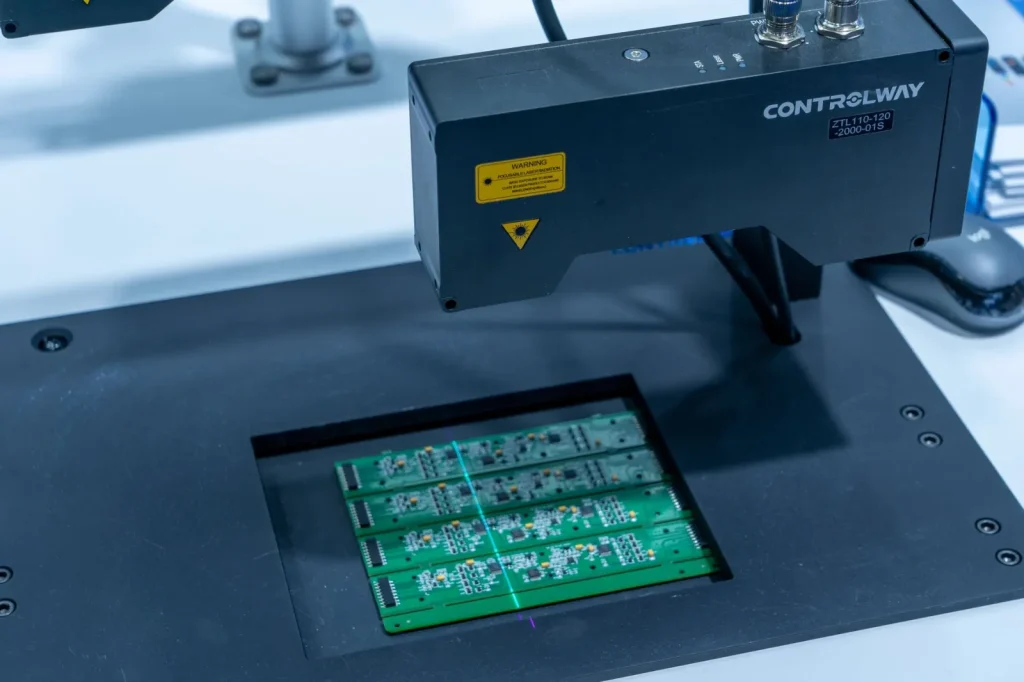
The particle sensor is my favorite part because you can almost see it working. A small fan pulls a steady stream of room air through a narrow channel. Inside that channel sits a laser diode pointed across the path.
When a particle drifts through the beam, it scatters a tiny flash of light. A photodetector sitting off to the side catches that flash.
Counting flashes, then guessing mass
Each flash is one particle. The brightness and duration of the flash hint at the particle’s size, so the sensor sorts them into rough size buckets. This is why the technology is called optical, or light-scattering, particle counting.
Here is the part people miss. Your screen shows PM2.5 in micrograms per cubic meter, which is a measure of mass. But the sensor only counted particles and estimated their size. It converts count and size into mass using an assumed particle density and shape.
The monitor never actually weighs anything. It counts light flashes and does math to guess the mass.
That assumption works well for typical household dust and cooking smoke. It works less well for particles that are unusually dense, very light, or shaped oddly, like some fibers.
Most home laser sensors cannot reliably see particles smaller than about 0.3 microns. Ultrafine particles from gas stoves and candles exist below that line, so a “0” reading does not always mean truly clean air.
How metal-oxide gas sensors sniff VOCs
The warm little can I mentioned is the gas sensor, usually a metal-oxide semiconductor, or MOX. It contains a film of tin dioxide heated to a few hundred degrees. That heat is why the sensor draws power and why it needs a warm-up.
When gas molecules in the air touch the hot surface, they react with it and change the film’s electrical resistance. The chip measures that resistance change and reports it as a signal.
Why it says “VOC” and not a chemical name
The catch is that a MOX sensor is not selective. Cooking odors, cleaning spray, rubbing alcohol, perfume, off-gassing from a new couch, all of these nudge the resistance in the same direction.
So the sensor reports a single blended number, often labeled TVOC (total volatile organic compounds) or just an air quality index. It cannot tell you that the spike was formaldehyde versus the acetone from your nail polish remover. If you care about what VOCs are in the home and why they matter, that broad sensitivity is exactly why a monitor flags “something,” not “this specific thing.”
| Sensor type | What it detects | What it reports | Main blind spot |
|---|---|---|---|
| Laser particle counter | Airborne particles via light scatter | PM2.5 / PM10 mass estimate | Very small (under 0.3 micron) particles |
| Metal-oxide (MOX) gas | Reactive gas molecules on a hot film | TVOC index, sometimes eCO2 | Cannot identify a specific gas |
| NDIR carbon dioxide | CO2 absorbing infrared light | True CO2 in ppm | Costlier, larger, so often skipped |
The carbon dioxide question, and a common trick
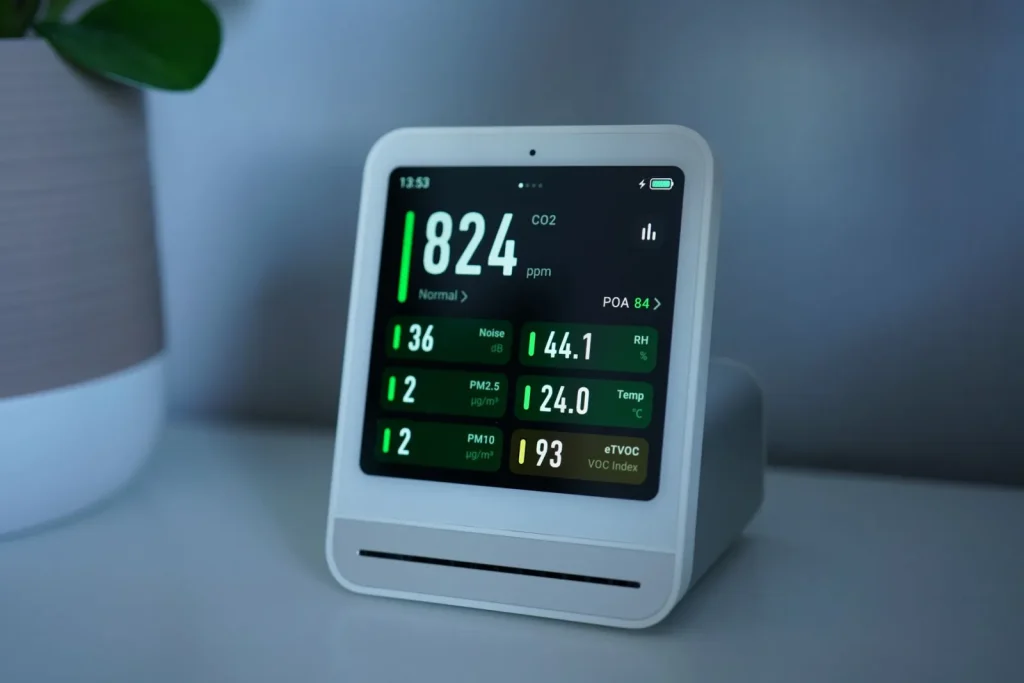
A lot of budget monitors proudly show a CO2 number. Read the fine print and you will often see “eCO2” or “CO2 equivalent.” That is not a real carbon dioxide measurement.
What is happening: the MOX gas sensor takes its VOC signal and estimates a CO2 value from it, on the theory that human breath raises both VOCs and CO2 together. In a stuffy bedroom the guess is decent. Open a window and light a scented candle, and the estimate can drift far from reality.
A true CO2 reading comes from a different sensor entirely, called NDIR (nondispersive infrared). It shines infrared light through an air sample, and since CO2 absorbs a specific infrared wavelength, the sensor measures how much light is missing. NDIR sensors are accurate and stable, but they cost more and take up more space, so many small monitors leave them out.
Want to know if your monitor truly measures CO2? Search the spec sheet for “NDIR.” If you only see “eCO2” or “estimated,” the number is derived from the VOC sensor.
What throws the readings off
Even a well-built monitor has predictable weak spots. Knowing them keeps you from overreacting to a single scary number.
- Warm-up drift. MOX sensors need time to stabilize, sometimes 24 to 48 hours after first power-on, before VOC readings settle.
- Humidity sensitivity. High moisture can inflate both particle and gas readings, so a foggy bathroom may look worse than it is.
- Sensor aging. The MOX film slowly drifts over months and years, which is why many devices auto-calibrate to a rolling baseline.
- Placement. A monitor next to the stove or a drafty window sees a very local snapshot, not the whole room.
This is the reason I tell people to watch trends, not chase single digits. A monitor that reads 12 today and 60 during dinner is telling you something useful about cooking, even if neither number is lab-precise.
Reference-grade versus home-grade
It helps to know what you did not buy. The regulatory monitors that agencies use cost thousands of dollars and often physically collect particles on a weighed filter, or use calibrated instruments checked against standards.
Your home unit is a low-cost sensor, and the U.S. EPA has published research on exactly how these consumer sensors compare to reference instruments. The short version from that work: home monitors are great for spotting changes and relative trends, less reliable as an exact scientific measurement. You can read more through the EPA Air Sensor Toolbox and general EPA indoor air quality pages.
Putting the hardware knowledge to use
Next time your monitor blinks red, picture what is actually happening inside. A fan is pulling air past a laser, and a hot chip is reacting with whatever gas floated by. Neither one is a laboratory, and both are guessing more than the clean display suggests.
That is not a reason to distrust the device. It is a reason to treat it as a smoke-alarm for air quality: excellent at saying “something changed, pay attention,” and honest enough, once you know its limits, to guide when you cook with the fan on or crack a window. Check the spec sheet for the sensor names, give a new unit a couple of days to settle, and let the trends, not any single number, tell the story.
Frequently asked questions
Do home air quality monitors actually measure PM2.5 accurately?
They estimate it. A laser counts particles and guesses their size, then converts that into a mass number using assumed density. For typical dust and cooking smoke this is reasonably close, but the reading is an approximation, not a weighed measurement like reference-grade equipment produces. Trends over time are more trustworthy than any single micrograms-per-cubic-meter figure.
What is the difference between real CO2 and eCO2 on my monitor?
Real CO2 comes from an NDIR sensor that measures how much infrared light carbon dioxide absorbs. eCO2, or estimated CO2, is a guess calculated from the VOC gas sensor based on the assumption that breath raises both together. eCO2 is fine for spotting a stuffy room but can drift far off when other gas sources are present, like candles or cleaning products.
Why does my monitor say VOC instead of naming a specific chemical?
Home units use a metal-oxide gas sensor that reacts to many gases at once. Cooking fumes, perfume, alcohol, and off-gassing furniture all shift its signal the same way. The sensor cannot separate them, so it reports one blended TVOC number. Identifying a specific compound like formaldehyde requires far more expensive lab instruments.
How long should a new air quality monitor warm up before I trust it?
The particle sensor works almost immediately, but the metal-oxide gas sensor needs time to stabilize. Many need 24 to 48 hours of continuous running to settle their VOC baseline. During that window, VOC and eCO2 readings may swing widely. Give a fresh unit a couple of days before reading much into its gas numbers.
Can these sensors detect ultrafine particles from candles or gas stoves?
Usually not well. Most home laser counters struggle to see particles smaller than about 0.3 microns, and many ultrafine particles fall below that. That means a low or zero PM2.5 reading during candle burning does not guarantee the air is truly free of the smallest, and often most concerning, particles.
Does humidity affect air quality monitor readings?
Yes, noticeably. High humidity can make water droplets scatter light like particles, inflating PM readings, and moisture also shifts metal-oxide gas sensor behavior. A steamy bathroom or a humid summer day can push numbers higher than the actual pollutant level warrants. Some better monitors apply humidity correction, but many budget units do not.

Dharm Solanki
Dharm Solanki spends a lot of time thinking about the air inside people's homes, usually when no one else is. He writes about humidity, ventilation, and dehumidifiers, along with the small fixes that turn a stuffy or damp room into one that feels comfortable again. He would rather explain why a recommendation works than just point at a product, so his guides tend to answer the question you were about to ask next. And if something looks great on paper but struggles in a normal house, he says so.