
On this page
The first house I ever tested with a real meter looked perfectly normal. Nice family, tidy rooms, no visible problem. But everyone kept getting bloody noses in January and nobody knew why. I clipped a hygrometer to the kitchen wall, waited an hour, and watched it read 22 percent. That house was as dry as a desert canyon, and no one had the faintest idea.
That is the thing about humidity. You feel its effects long before you name the cause.
Get the moisture level right and a surprising number of nagging home complaints simply fade. This is the front door to everything we cover about home comfort, so let me lay out the whole picture in one place.
What counts as ideal indoor humidity
The short answer: 30 to 50 percent relative humidity. That range is echoed by the EPA, ASHRAE, and just about every building science group that has studied the question.
Relative humidity (RH) is the amount of water vapor in the air compared to the most it could hold at that temperature. It is shown as a percentage. At 100 percent RH the air is fully saturated and water starts condensing on your windows.
Target 40 to 45 percent RH for most of the year. It is comfortable, it keeps mold at bay, and it is easy to hold with normal equipment. Treat 30 and 50 as the guardrails you do not want to cross for long.
Why not just pick one perfect number? Because the sweet spot shifts with the weather outside and the room you are standing in. A nursery, a wine rack, and a basement gym all have slightly different needs. More on that below.
Why the range matters for your health

Your body notices humidity more than you might think. The EPA’s indoor air quality pages point to the 30 to 50 percent band partly because it is where common irritants stay in check.
When the air is too dry
Below about 30 percent, the trouble starts. Skin cracks and flakes. Lips chap. The mucus lining in your nose dries out, which is exactly why those bloody noses showed up in that January house.
Dry air also lets viruses linger longer and leaves your sinuses raw and inflamed. If you wake up with a scratchy throat every winter morning, low humidity is a prime suspect. We dig into that in Humidity and Sinus Problems and Humidity and Dry Skin Explained.
Then there is the static. Every doorknob becomes a tiny lightning strike. That is dry air stealing electrons, and it is covered in Why Dry Air Causes Static Electricity.
When the air is too damp
Push past 50 percent and a different set of problems wakes up. Dust mites thrive above 50 percent RH. Mold spores need moisture to grow, and they find it fast on cool wall surfaces and in closets.
Damp air does not just feel worse. It actively grows the things that trigger allergies and asthma.
The clammy, heavy feeling you get in a muggy room is your sweat failing to evaporate. Your body cools itself through evaporation, and when the air is already loaded with water, that cooling stalls. You feel hotter at 78 degrees and 60 percent RH than at 80 degrees and 40 percent.
What humidity does to the house itself
Your home has feelings about moisture too, and it expresses them in expensive ways.
Too dry, and wood shrinks. Hardwood floors develop gaps you can slide a nickel into. Trim pulls away from walls, doors rattle in their frames, and piano tuning drifts. Hardwood in particular wants a steady 35 to 55 percent, which we spell out in Ideal Humidity for Hardwood Floors.
Too damp, and the opposite happens. Wood swells, doors stick, paint peels, and condensation pools on window sills. Left long enough, that moisture rots framing and feeds mold behind the drywall where you cannot see it.
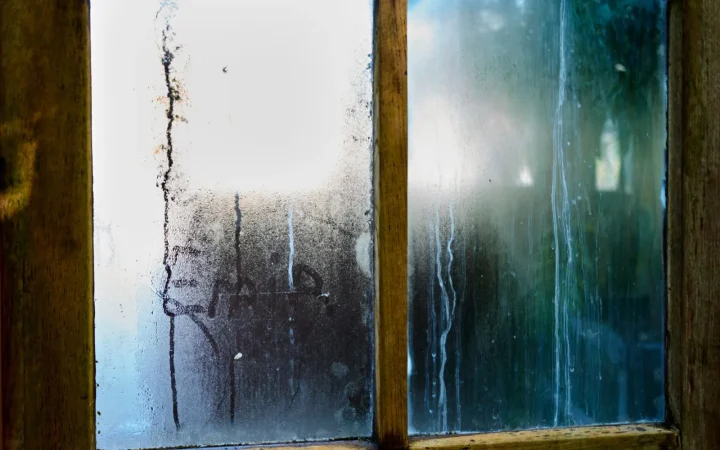
Condensation on the inside of your windows in winter is not a window problem. It is a signal that indoor humidity is too high for the outdoor temperature. Lower the moisture before you blame the glass.
How the target shifts by season

Here is the part people miss. The 30 to 50 percent rule bends with the seasons because cold windows change the math.
In winter, cold outdoor air holds almost no moisture. When it seeps in and warms up, RH drops fast, which is why homes go bone dry from December to March. You often need a humidifier to climb back toward 35 or 40 percent. But push too high and you get window condensation, so winter targets actually run a touch lower. See Ideal Indoor Humidity in Winter.
In summer, the problem flips. Warm, wet outdoor air pushes indoor levels up, and the job becomes removing moisture with a dehumidifier or your air conditioner. Ideal Indoor Humidity in Summer walks through the summer targets.
| Season | Practical target RH | Main tool |
|---|---|---|
| Winter (cold, dry) | 30 to 40 percent | Humidifier |
| Summer (warm, humid) | 40 to 50 percent | Dehumidifier or AC |
| Spring and fall (mild) | 40 to 45 percent | Often neither |
Why different rooms want different numbers
A house is not one climate. It is several small ones stacked together.
Bedrooms do best around 40 to 50 percent for easy breathing and good sleep, which is the focus of Best Bedroom Humidity for Sleep. A baby nursery leans similar but deserves its own careful eye, covered in Ideal Humidity for a Baby Nursery.
Basements run damp and often need a dehumidifier running most of the summer. Bathrooms spike to 80 or 90 percent during a shower, which is normal, as long as a fan clears it within twenty minutes so it does not linger and feed mold.
Buy two or three cheap hygrometers, not one. Put them in the bedroom, the basement, and one problem room. A single reading in the hallway hides big swings happening elsewhere in the house.
How to actually measure and hit your target
You cannot manage what you do not measure, and a mistake I see constantly is people guessing. They swear a room is fine, and the meter says 24 percent.
Start with a digital hygrometer. A decent one runs $10 to $20. Place it away from vents, exterior doors, and direct sun, then give it an hour to settle before you trust the reading.
- Put a hygrometer in each of your main living spaces and check it for a week
- Note the daily high and low; you are looking for time spent outside 30 to 50 percent
- Run bathroom and kitchen exhaust fans during and after moisture-heavy activities
- Add a humidifier in winter or a dehumidifier in summer only after you know your real numbers
- Recheck a month later to confirm the change actually held
For whole-home fixes, the Department of Energy’s Energy Saver guide is a solid, unbiased reference on ventilation and moisture control that will not try to sell you anything.
Where to go from here
If you do just one thing this week, put a $12 meter on the wall and watch it for seven days. That single habit tells you whether you have a dry-air problem, a damp-air problem, or, happily, no problem at all.
From there, the fix is usually small and cheap. Match the season, mind the rooms that misbehave, and keep the whole house drifting inside that 30 to 50 percent band. Your skin, your sinuses, and your floorboards will all quietly thank you.
Frequently asked questions
What is the single best indoor humidity number to aim for?
If you want one target, aim for 45 percent relative humidity. It sits right in the comfortable middle of the 30 to 50 percent range, keeps mold and dust mites in check, and is gentle on wood floors and furniture. In practice you will drift a little lower in cold winter weather and a little higher in humid summers, and that is fine.
How do I measure indoor humidity at home?
Use a digital hygrometer, which costs about $10 to $20 at any hardware store. Place it away from heat vents, exterior doors, and direct sunlight, then wait an hour before reading it. For a real picture, use two or three meters in different rooms, since a basement and a bedroom can easily read 15 points apart on the same day.
Is low or high humidity worse for you?
Both cause trouble, just different kinds. Low humidity below 30 percent dries out skin, lips, and sinuses and creates static shocks. High humidity above 50 percent feels clammy and grows mold and dust mites that trigger allergies and asthma. Damp conditions tend to do more lasting damage to a house, but dry air is the more common indoor complaint in winter.
Why does my house get so dry in winter?
Cold outdoor air holds almost no moisture. When that air leaks into your home and your heating system warms it up, the relative humidity drops sharply, often into the 20s. This is why winter feels so dry even without any obvious leak. A humidifier is usually the fix, though you want to avoid pushing so high that windows start condensing.
Can I fix humidity without buying expensive equipment?
Often, yes. Running bathroom and kitchen exhaust fans, using lids on pots, venting your dryer outside, and airing out damp rooms all help. Houseplants and open water can nudge dry air upward slightly. Only when those basics fall short do you need a humidifier or dehumidifier, and even those start around $40 to $60 for a small room.

Dharm Solanki
Dharm Solanki spends a lot of time thinking about the air inside people's homes, usually when no one else is. He writes about humidity, ventilation, and dehumidifiers, along with the small fixes that turn a stuffy or damp room into one that feels comfortable again. He would rather explain why a recommendation works than just point at a product, so his guides tend to answer the question you were about to ask next. And if something looks great on paper but struggles in a normal house, he says so.